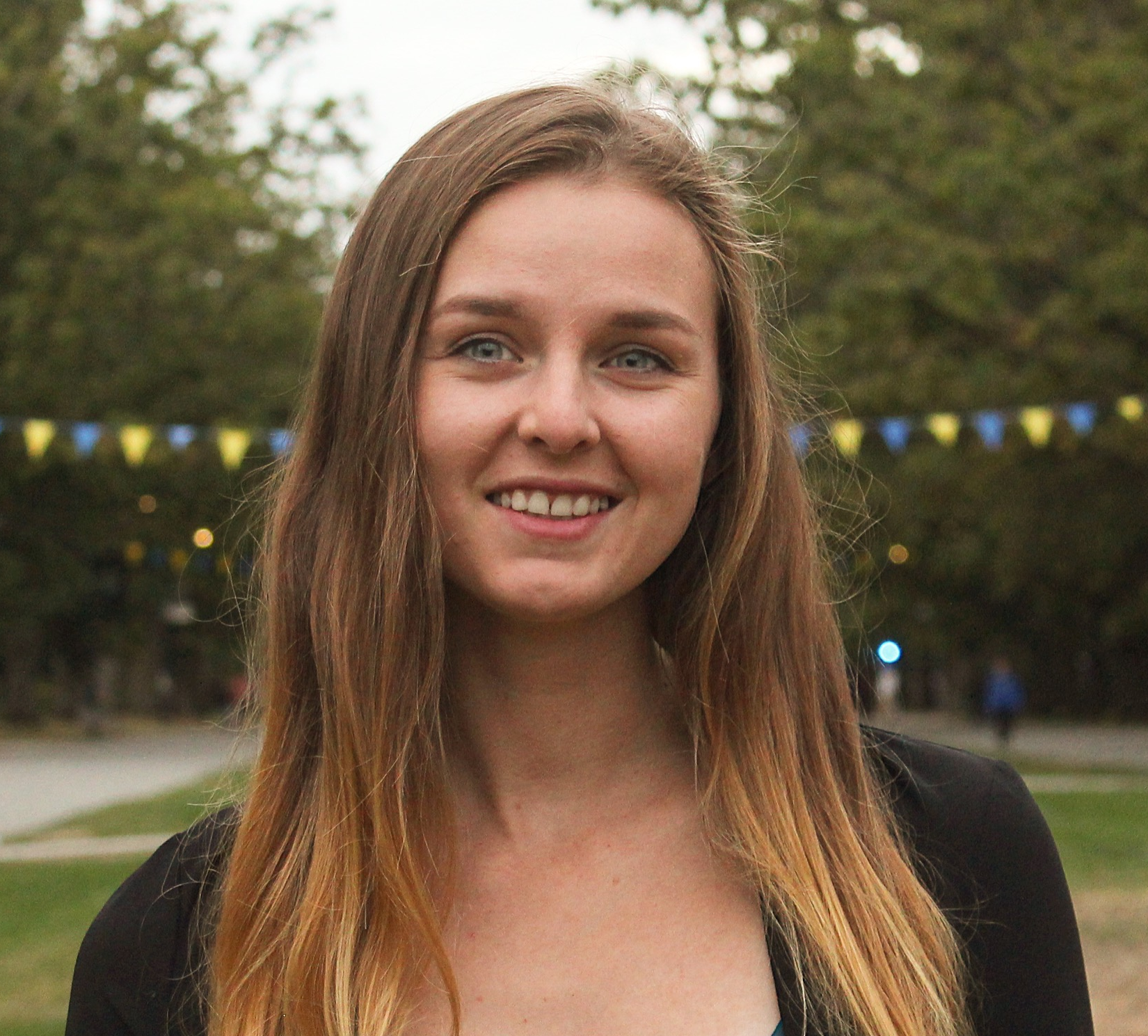
Student Type: Women in Technology Scholarship Recipient

Marlie Russell

My Brain Wasn’t Made To Memorize Microbes. 

Q & A with Marlie Russell, computer science, UBC Okanagan

When British Columbia was burning in 2017, UBC Okanagan computer science student Marlie Russell was out there fighting the fires near her home town of Williams Lake. She credits hauling heavy equipment up mountainsides in scorching heat for sharpening her work ethic, devising workarounds on faulty pumps for honing her troubleshooting skills, and proving herself on the fire-line with the support of her crew for strengthening her self-worth — all skills she knows she’ll need as she carves a path for herself and for other women in computer science.

The Irving K. Barber British Columbia Scholarship Society recognizes Marlie as a trailblazer in her field with the 2018 Women in Technology Scholarship ($10,000).

We caught up with Marlie to get the scoop on her connection to tech.

Q: Can you give us a snapshot of your current interests in computer science?

A: Computer science is all about problem solving, and my favourite problems to solve involve figuring out the most efficient way to store and access data under certain circumstances. With this, I want to move back to the Cariboo (where I’m from) and work in the natural resource industry.

Q: Why is scholarship support important for young women in the tech community?

A: Women should know that they have a huge range of career options, including a career in technology. The Women in Technology Scholarship has incredible value in encouraging women to pursue a career in technology by increasing awareness that this option exists, and that it can be an incredibly rewarding field to be in. I didn’t actually know that computer science was a field of study until my second year at university!

Q: What drew you to tech? And specifically to computer science?

A: I was studying biology and chemistry previously, but I don’t think my brain was made to memorize hundreds of microbes! A few of my crew members in firefighting were studying engineering, and I always eavesdropped on their conversations when they talked about their studies because it sounded so much more interesting than what I was learning, so I switched to mechanical engineering where I took my first coding course. To my surprise (and everyone else’s), I was good at it and I loved it, so I switched my major again, and I’ve been studying computer science since.

Q: What have been some of your challenges as a woman in this field?

A: The biggest challenge has been scouting out other women in my classes and grabbing a seat next to them! We usually make friends fast, then make more friends with the students around us, so our study groups are always a mixture of men and women. This is incredibly helpful, since we all approach problems differently — and to solve complex problems, it’s important to have as many perspectives as we can get.

Q: What do K–12 schools need to change in order to better support girls in their pursuit of computer science, engineering and math?

 A: The biggest change would be increasing awareness, and that has already been happening. My younger brother took a coding course in high school, but I had no idea our school even offered it. I was determined to be a doctor, so I only looked at the biology and chemistry courses, and had horse-blinders on for technology courses, but I am certain that there are plenty of elementary and high school students who would get a lot of value from technology education if they knew it was there.

Q: What advice do you have for girls who are considering studying or working in tech?

A: Start by taking an intro to coding course. The first step is to learn the language, then you learn how to use it. If you enjoy creative problem solving and logic, then try computer science — but also know that you have the freedom to choose any career path you want. Don’t go into technology if you don’t want to, but please don’t discard it as a potential career until you have explored it enough to know it’s not for you. And for the record, I think working in technology is marvellous.

Q: What’s your dream job?

 A: My dream job? I would actually love to be a mom! Since I also love computer science, working in technology is perfect for me: I can work from home if I need, and have flexible hours. I’d be doing my two greatest passions, so . . . could life get any better?

 Congratulations, Marlie. We wish you all the best as you push yourself to ever greater heights.

Stay posted for more profiles of our winners of the Women in Technology Scholarship. This scholarship is a significant opportunity to support women’s advancement in the fields of engineering, math and computer science in British Columbia. If you’re a young woman in tech, or if you know of someone who is, spread the word: there’s a whole new round of applications slated for 2019!


Natella Jafarova

I Thought That Only a Genius Would Pursue a Math Degree. 

Q & A with Natella Jafarova, statistics, University of Victoria

When she was a little girl living in Azerbaijan, a career in math and statistics was most definitely not on Natella Jafarova’s radar. Despite her interest in math from an early age, her relatives encouraged her to pursue occupations that were “more appropriate” for women. All that changed when her family moved to Canada during her middle school years. Suddenly, Natella was surrounded by educators who encouraged her to learn more and excel in her studies — so she did, seizing every learning opportunity that came her way.

Natella’s learning and achievement is still going strong: she is one of ten recipients of the 2018 Women in Technology Scholarship ($10,000) from the Irving K. Barber British Columbia Scholarship Society.

Here, Natella describes her path to success.

Q: Tell us about your current interests in your field.

A: As a statistics major I am highly interested in — you guessed it — data. More specifically, I am interested in the analysis of big data in order to find patterns and make decisions based on the outcomes. We live in the age where data is constantly being recorded, and I believe that we can gain a better understanding of world problems if we analyze the patterns within data.

Q: What do you love about math and stats?

A: I love how logical it is. When I was studying biochemistry, most of my studying was memorization, which gave me little opportunity to think for myself. But when I switched into mathematics/statistics, I found that in class we were given a set of tools to use on solving a problem. So, when faced with a problem, there was always a logical way to get to the answer using various mathematical methods, which for once made me think outside the box.

Q: Tell us about yourself in high school. Were you a math nut?

 A: Surprisingly no! I was pretty good at math, but at the same time I was terrified of it. In my mind, I thought that only a genius would go into post-secondary school to pursue a degree in mathematics, which I am definitely not. However, soon after starting university and seeing many of my peers (who had an affinity for the subjects that they were studying) start failing their courses, I realized that a person’s natural ability is not enough to succeed. While it does help to have an affinity for certain subjects, you will not thrive unless you study hard and remain determined to succeed no matter what. This is what eventually led me to realize that I was capable of succeeding in mathematics, which prompted me to switch majors from biochemistry to statistics.

 Q: What do K-12 schools need to change in order to better support girls in their pursuit of computer science, engineering and math?

 A: When I was in high school, we did not have any exposure to programming in a classroom setting. It was very much pen-and-paper traditional learning, which I think did little to help us explore what was out there. Nowadays, people in the industry will rarely do anything that involves pen and paper, as most things are done by programs. I graduated from high school just over four years ago, so this was the standard way of teaching very recently. I’ve heard that schools are now trying to implement more tech-focused learning in K-12, which I think is amazing. I actually have a friend who recently did her teaching practicum in a grade 4 classroom, where they were teaching programming. It looked like a great opportunity, and the kids had created some cool looking projects by the end of the term. I think if programming was to become a part of the curriculum, more girls would become interested in pursuing computer science/engineering/math.

Q: As you see it, where are some of the biggest opportunities for women in tech?

A: With BC’s tech industry alone generating just over $29 billion in revenue and providing over 100,000 high paying jobs, I think that there is an immense amount of opportunity for women to pursue careers in the field. New start-ups, as well as established companies, are constantly on the lookout for hiring talented individuals. With such a tremendous amount of companies to choose from, I don’t see women having a hard time finding opportunities which they feel passionate about in the tech field.

Q: What advice do you have for girls who are thinking about studying or working in tech?

 A: I say do it if it makes you happy. Obviously, the tech industry isn’t for everybody, but if you enjoy solving diverse problems on the daily, then I suggest that you explore what the tech industry has to offer. I think a lot of young people are pressured to choose their career paths from a very young age, but then halfway through their degrees regret their decisions (this had actually happened to me). But they still continue with their chosen path because they are already so far along in their studies. The great thing about the tech industry is that you can start your career at any point in your life. I have seen people from many different educational backgrounds who are now working in tech and have prosperous careers there. So, it’s never too late to start!

Q: What’s your dream job?

A: This is a tough one because I want a job where I am constantly learning and growing with my interests, and having a single job title may not encapsulate all of that. However, based on my current interests, I think that data science is where I want to eventually end up, as it will allow me to build algorithms and use statistical methods to find and analyze big data.

Thanks, Natella — and congratulations again. We wish you all the best in your studies and in your career.

Emilie Boras

You Probably Shouldn’t Do That. You’ll Get Grease All Over Your Clothes.

 Émilie Boras awarded $10,000 to support her mechanical engineering degree

In high school, Émilie Boras liked physics. She liked bio. And she liked knowing how things worked. “Blame this need on watching too much Discovery Channel How It’s Made in my youth,” she quips. But despite her interest in science and engineering, she still fell prey to gender bias in the school system: “In high school I wanted to take auto shop as an option and I was discouraged,” she recalls. “I was told, No you probably shouldn’t do that. You’ll get grease all over your clothes.

It made sense at the time . . . sort of. Émilie took a different class instead. “But now,” she says, “looking back on it, it’s like WHAT?! That shouldn’t be the basis for not doing something I wanted to do.”

Nowadays she doesn’t let gender bias stop her, even though it’s a constant challenge. Now in her second year of mechanical engineering at UBC (the third year of her degree), Émilie has found a way to combine her interest in all of these areas. She’s studying mechanical engineering, with an interest in bioprinting and exoskeletons (albeit with a growing interest in marine engineering).

Less than a quarter of Émilie’s classmates are women — and she feels it, every day. There aren’t many female role models on campus in the tech space, and while she has met some accomplished female engineers working in industry, there’s a lack of mentorship and support for women undergraduate students in the field. “The Women in Engineering group here at UBC organized a mentorship night where we got to speak to three women in industry and that was excellent,” Émilie says. “However it was just for a night. It’d be nice to have a mentor constantly throughout the year, or maybe even just the first year, or just at times where you need some support. Any kind of group where you can discuss your struggles or empathize with someone else who’s been experiencing the same thing is also very encouraging.” She suggests peer-to-peer tutoring by older female students as a place to start.

Besides her natural tenacity and conviction that she has just as much right to be in mechanical engineering as her male peers — and the conviction that she is equally capable as they are — Émilie got a boost of confidence from a $10,000 scholarship for Women in Technology from the Irving K. Barber British Columbia Scholarship Society. It’s a huge help, especially since she lives in Vancouver where the cost of living is high. “But if anything, the scholarship was more significant in that it was so motivational,” she says. “I know at least personally that I’ve been discouraged so many times in engineering. I just feel like I’m either not doing enough, or I’m not good enough, or I don’t belong there, or things like that, but it definitely reconfirmed: You’re doing the right thing. You’re in the right place. It’s fine.”

To other young women who are aspiring to careers in tech, Émilie says to stay true to your interests, and don’t give up. Ask questions. Be okay with failure. Keep your confidence high, because you’re worthy of being in engineering or computer science or tech. “Be more affirmative,” she says. “If you know that it’s right, you should be saying it with confidence — because people will listen better if you do it that way. And even if they do interpret you as being more authoritative or “bossy”: Whatever! You’re getting the work done!”

Congratulations, Émilie. We wish you well as you challenge gender bias at every turn, spreading encouragement for other women as you go.

Jobina Tamminga

Watch Me. I’ll Do What I Want To Do.

 First Nations student Jobina Tamminga receives $10,000 to support her studies in computer science and biology

For third-year UBC student Jobina Tamminga, her combined major in biology and computer science delivers enormous enjoyment — but it also comes with a hefty price tag. “Since I’m First Nations, normally you get your post-secondary paid for,” Jobina says. “But with my band, there’s only so much money, and there wasn’t enough to cover all students.” In her first two years of university, Jobina worked about 20 hours a week waiting tables, on top of her full course load, to cover her costs. Student loans helped, too.

This year, it’s a different story. Jobina gratefully received funding from her band, the Timiskaming First Nation in Quebec, taking the pressure off for tuition. And on November 13 at a ceremony at Government House in Victoria, Jobina was honoured as one of ten recipients of a $10,000 Women in Technology Scholarship from the Irving K. Barber British Columbia Scholarship Society (IKBBC) to support women studying math, computer science and engineering.

The scholarship will help Jobina pay back her student loans upon graduation, and eases the pace of life a little. “It allows me to full-on focus on what I’m studying, and explore some of my interests as well,” she says. “And it gives me time to relax!”

While the substantial sum goes a long way to help with post-secondary costs, Jobina says the real award is the acknowledgment of her efforts. “This is such a large amount of money that it allows women to take pride in what they’re doing,” she says. “It makes them think, Wow, what I’m doing is important. It also encourages them to continue on the path that they’re doing.”

While Jobina has a bright future ahead in her chosen field of bioinformatics, she didn’t always have her sights set on a degree in tech. In fact, she started at UBC intending to complete a BA in psychology. But upon taking a computer science elective during her first year, she was hooked. “It was my best mark in university,” she recalls. “I fell in love with it.” She switched out of arts, designing a double major in biology and computer science — biology because genetics fascinates her, and comp sci because she enjoys using logic and math to solve real-world problems.

It’s fair to say Jobina has worked hard to get here. She takes her studies seriously and keeps her grades high. During high school, she travelled to a city near her small community in order to finish physics 12, as it wasn’t offered at her school. And growing up, she watched her single mother raise four children while putting herself through university. “Seeing her push through people’s expectations [really helped],” Jobina says. “It was like, Oh, you have four kids, you can’t do that, and my mum was like, Watch me. I’ll do what I want to do. She definitely inspired me to push through my boundaries as well.”

It’s an outlook that has helped Jobina follow her own interests to great success, and she counsels girls to do the same: “The biggest thing is, if you’re considering whether [tech] is something you want to pursue, try it out in as many ways as you can,” she says. “Sticking to your passions and focusing on what will make you happy has helped me. It doesn’t matter if other people don’t think you can succeed or if they don’t approve. As long as you know that this is what you want to do.”

Congratulations, Jobina. We wish you well as you explore and design a deeply satisfying and rewarding career in tech.